
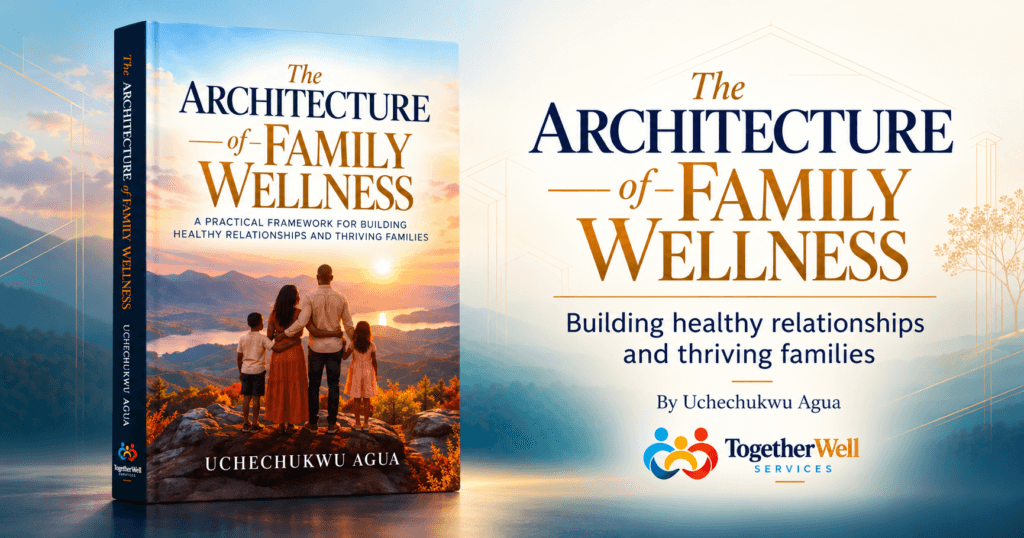
Understanding What Makes Families Strong, Healthy and Able to Flourish
A book by Uchechukwu Agua
Strong Families Are Built
Every family has a story. Every family carries strengths, responsibilities, expectations and challenges. Some families appear successful from the outside while quietly struggling with communication, connection, conflict or competing demands.
What helps a family live well?
The Architecture of Family Wellness explores this important question through a practical, integrated understanding of family life.
The book presents family wellness not as the absence of difficulties, but as something that can be understood, strengthened and intentionally developed. It invites readers to look beyond isolated problems and recognise how personal wellbeing, relationships, communication, parenting, responsibilities, family organisation and the wider environment interact.
Drawing on evidence-informed perspectives, African family realities and faith-sensitive reflection, the book offers a framework for understanding family life and developing practical strategies for healthier relationships.
More Than a Book About Family Problems
Families do not flourish simply because they avoid conflict or maintain appearances.
They need relational security, meaningful connection, healthy communication, responsible partnership, effective caregiving, workable routines, appropriate boundaries and a shared sense of direction.
They also need the capacity to adapt when life changes.
The Architecture of Family Wellness brings these dimensions together into one coherent framework, helping readers understand both the strengths that support family wellbeing and the patterns that may weaken it.
Its central invitation is simple:
Understand your family more clearly. Strengthen what matters. Build intentionally towards greater family wellbeing.
What Is Inside the Book?
The Architecture of Family Wellness takes readers on a journey from understanding family life to developing practical strategies for strengthening it.
The book is organised into four interconnected parts.
Part I — Understanding Family Wellness
The opening chapters establish the foundations for understanding what family wellness means and why healthy families must be intentionally built.
Readers explore the family as a living system, the changing demands of family life, the influence of the wider environment, and the ways culture and faith shape family experiences.
This part helps readers move beyond simplistic explanations of family problems towards a more comprehensive understanding of family wellbeing.
Part II — The Architecture of Family Wellness
At the heart of the book is the TogetherWell Family Wellness Architecture.
This framework brings together the essential dimensions of family life, showing how they interact to support or weaken wellbeing.
It begins with Personal Capacities & Wellbeing as the Ground and Relational Security & Belonging as the Foundation.
Seven structural pillars support the Architecture:
- Relational Engagement & Nurture
- Communication & Emotional Processes
- Conflict, Repair & Problem-Solving
- Partnership, Power & Roles
- Parenting, Caregiving & Development
- Family Organisation, Routines & Resources
- Relational Boundaries, Interdependence & Networks
The framework also recognises the importance of Shared Identity, Meaning & Direction, the coordination of coparenting responsibilities, and the cross-cutting importance of Safety, Dignity & Protection and Adaptive Capacity & Family Resilience.
Together, these dimensions support Family Wellbeing, with Family Flourishing representing the wider developmental horizon.
Part III — Protecting and Strengthening Family Wellness
Families experience pressure, transitions, disappointments and unexpected challenges.
This part examines how families respond when their wellbeing is threatened, how resilience can be strengthened, and how weakened relational patterns may be repaired.
It also addresses the importance of recognising when a family needs support beyond what a book, educational resource or ordinary relationship strategy can provide.
Part IV — Building Your Family Wellness Blueprint
Understanding family wellness is important. Applying that understanding is where meaningful change begins.
The final part guides readers through a structured process of examining their family experiences, identifying recurring patterns, defining priorities, developing practical strategies, implementing change and reviewing progress.
It culminates in the 90-Day Family Wellness Blueprint, helping readers translate learning into realistic actions suited to their family circumstances.
The goal is not to create a perfect family.
It is to help individuals and families make thoughtful, responsible and sustainable progress towards healthier family life.
Who Is This Book For?
The Architecture of Family Wellness is written for people who want to understand family life more deeply and contribute intentionally to healthier relationships.
Individuals Seeking Personal and Relational Growth
Whether you are single, preparing for marriage or reflecting on your place within a family, this book can help you understand how personal capacities, experiences, choices and relationships contribute to family wellbeing.
Couples and Married Partners
For couples, the book offers a broader perspective on marriage and partnership. It explores connection, communication, conflict, responsibilities, power, shared direction and the wider family relationships that influence life together.
It encourages couples to move beyond identifying problems towards understanding patterns and developing responsible strategies for change.
Parents and Caregivers
Parenting takes place within a wider family environment.
The book helps parents and caregivers consider how relationships, household organisation, coparenting, developmental needs, emotional processes and family pressures interact to shape caregiving experiences.
Families Navigating Change or Pressure
Financial strain, relocation, caregiving demands, changing family roles, bereavement and major life transitions can affect family wellbeing.
This book provides a framework for understanding how different areas of family life may be affected and identifying realistic priorities for strengthening them.
Family-Life Educators, Coaches and Community Leaders
The book can also serve as a conceptual and educational resource for professionals, faith leaders, facilitators and community organisations supporting individuals, couples and families.
Its framework encourages structured reflection, contextual sensitivity, ethical boundaries and appropriate referral when specialised support is needed.
How to Use This Book
You do not need to read The Architecture of Family Wellness as though you are preparing for an examination.
Read it with curiosity about your own family experiences.
As you progress, consider three questions:
What am I beginning to understand more clearly?
Notice the connections between different areas of family life. A recurring difficulty may be influenced by several factors rather than one person’s behaviour alone.
What strengths should we protect?
Family reflection should not focus exclusively on weaknesses. Identify the relationships, practices, values and resources that already support wellbeing.
What is one responsible step we can take?
Use the practical reflections and strategy tools to identify changes that are realistic, appropriate and proportionate to your circumstances.
The book encourages reflection without blame, accountability without humiliation, and improvement without the unrealistic expectation of perfection.
Where violence, abuse, coercive control or significant safety concerns are present, protection and appropriate professional support must take priority over ordinary joint family-improvement exercises.
From Understanding to Practical Action
The Architecture of Family Wellness is designed to help readers do more than understand family life. It encourages them to translate insight into practical, responsible action.
The final chapters introduce structured reflection and planning approaches that help readers examine their family experiences, recognise recurring patterns, identify priorities and develop realistic strategies for improvement.
Family Wellness Snapshot
A structured reflection process that helps readers consider their family’s strengths, areas of strain, different perspectives and wider circumstances.
The Snapshot is not a diagnostic test or a numerical rating of family health. It is a way of seeing family life more clearly so that appropriate next steps can be considered.
Family Pattern Map
Many family difficulties become easier to understand when we examine what keeps happening rather than focusing only on the latest disagreement.
The Family Pattern Map helps readers explore recurring interactions, including triggers, responses, reactions, escalation, outcomes and after-effects.
Its purpose is to support understanding and reflection, not to assign blame.
90-Day Family Wellness Blueprint
The book culminates in a practical planning process that helps readers translate their reflections into a focused strategy for strengthening family wellbeing.
The Blueprint encourages readers to identify meaningful priorities, develop realistic actions, implement agreed changes and review what they are learning over time.
The goal is steady, responsible progress—not perfection.

About the Author
Uchechukwu Agua
Family Life & Relationship Strategist | Co-Founder & Chief Executive Officer, TogetherWell Services
Uchechukwu Agua is a Pastor, family-life and relationship strategist, and an educator committed to helping individuals, couples and families build healthier relationships and flourish.
As Co-Founder and Chief Executive Officer of TogetherWell Services, he contributes to the development of family-life education, relationship strategy, parenting education and practical resources designed to strengthen individuals and families.
His approach brings together evidence-informed perspectives, culturally responsive practice, Christian values and an understanding of the realities affecting contemporary African families.
The Architecture of Family Wellness reflects his commitment to helping people move from simply recognising family difficulties towards understanding their relationships and intentionally building healthier patterns of family life.
Get the Book
Begin Your Family Wellness Journey
Whether you want to strengthen your marriage, become more intentional about parenting, understand recurring family challenges or develop a clearer direction for your household, The Architecture of Family Wellness offers a framework for learning, reflection and practical action.
Discover how the different dimensions of family life connect—and how intentional choices can contribute to healthier relationships and flourishing families.
Book availability and ordering information will be announced here.
Continue Exploring Family Wellness
You can begin strengthening your understanding of family wellness even before obtaining the book.
Explore TogetherWell’s Family Wellness Architecture, read our educational articles and use practical reflection tools designed to help you take your next responsible step.