
What Is Family Wellness — and Why Is It More Than a Happy Family?
TogetherWell Family Wellness | Teaching Transcript
Opening
Can a family love one another deeply and still be struggling?
Absolutely.
A couple can be committed to each other and still struggle to communicate.
Parents can love their children deeply and still feel overwhelmed.
A family can pray together and still have unresolved conflict.
And a family can look successful from the outside while something important inside the home needs attention.
That is why family wellness is more than being a happy-looking family.
What We Mean by Family Wellness
At TogetherWell, we define it this way:
Family wellness is not the absence of problems. It is the developing capacity of individuals and family relationships to function, connect, adapt, care and grow in ways that support the wellbeing of the people within the family.
And none of those capacities should be pursued at the expense of safety, dignity or protection.
In simpler terms, family wellness asks:
How are the people doing?
How are the relationships doing?
And how well is the family able to care, function and adapt together?
Family Wellness Is Not One Thing
One of the most important ideas is this:
Family wellness is not one thing.
Families are living systems.
Financial pressure can affect communication.
Exhaustion can affect parenting.
The quality of a couple relationship can affect the atmosphere around children.
Extended family can provide enormous support—and difficult expectations or boundaries can also create strain.
Health, work, culture, faith, caregiving, money and major life transitions can all shape family life.
So we need a way to see more than the problem that happens to be loudest today.
Introducing the Architecture
That is why TogetherWell developed the Family Wellness Architecture.
It helps us look at personal wellbeing and belonging, connection and nurture, communication, conflict and repair, partnership and roles, parenting and caregiving, family organisation and resources, boundaries and wider family networks.
It also helps us pay attention to shared meaning and direction, safety and dignity, and the family’s ability to adapt when life changes.
The full Architecture is on screen.
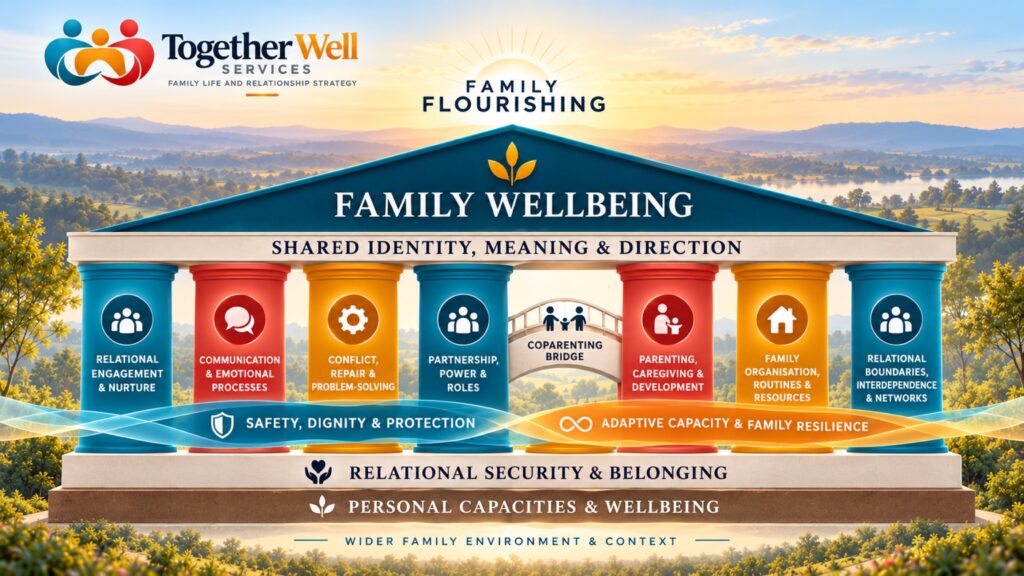
You do not need to memorise it.
Its purpose is to help you see that family life is interconnected.
Not a Score
And there is something else that matters.
The family is a profile, not a percentage.
A family can have real strengths and still have areas that need attention.
One family member may experience the household differently from another.
And one difficulty should not automatically become the definition of the whole family.
This is not about giving your family a grade.
It is about seeing clearly enough to know what may need strengthening.
Safety
There is one important exception to ordinary “strengths and challenges” thinking.
Where there is violence, abuse, coercion or another serious safety concern, strengths elsewhere in the family do not cancel that concern.
Safety concerns cannot be averaged away by strengths elsewhere in the family.
Closing
So here is a useful place to begin:
What is working in your family—and what deserves attention now?
You do not have to fix everything at once.
You simply need enough clarity to identify the next responsible step.
If you are new to TogetherWell Family Wellness, begin with the Family Wellness Starter Guide.
It will introduce the framework and help you identify which resource may be most useful for you next.