
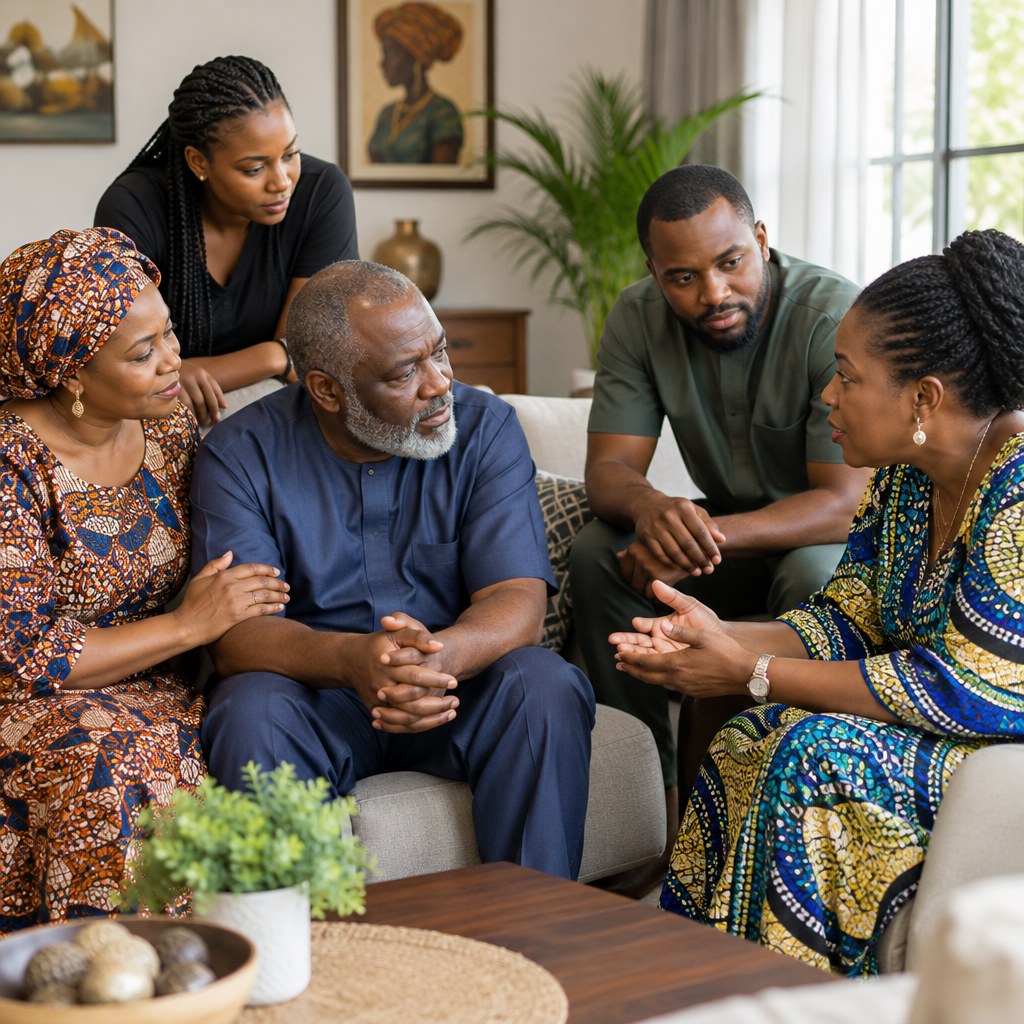
Why family strength is not simply about enduring difficulty, but learning how to respond when life changes.
1. When Family Life No Longer Works the Way It Used To
For several years, a Nigerian family has built its life around familiar routines.
The father manages a small business. The mother works in paid employment. Their two children attend school, while relatives occasionally assist with childcare.
Their arrangements are not perfect, but they generally work.
Then the father develops a medical condition that significantly limits his ability to work.
Income becomes less predictable. Hospital appointments require time and money. The mother takes on additional responsibilities, while the children notice changes they do not fully understand.
Relatives offer some assistance, but everyone is adjusting to unfamiliar circumstances.
The family cannot simply continue as before.
What does strength look like in this season?
Does it mean pretending everything is fine? Maintaining every previous expectation? Expecting one person to carry every additional responsibility?
Not necessarily.
Sometimes family strength is demonstrated not by keeping everything the same, but by recognising what has changed and developing responsible ways to live within a new reality.
This is where family resilience becomes important.
Resilience is not about denying hardship. It concerns how families respond to adversity, mobilise available support and develop workable ways of caring and functioning as circumstances change.
2. What Family Resilience Really Means
Family resilience is often described as the ability to bounce back after difficulty.
While this expression is familiar, it can be misleading.
Not every family can return to its previous circumstances. Some experiences permanently change how family life must be organised.
Family-resilience scholar Froma Walsh describes resilience through dynamic processes involving family belief systems, organisation, communication and problem-solving.
This understanding directs attention away from exceptional toughness towards the relationships, resources and practical responses involved in facing adversity.
Three related ideas deserve distinction.
Resilience concerns the processes and capacities through which families respond to adversity.
Adaptation involves adjusting responsibilities, expectations and arrangements to changed circumstances.
Family wellbeing concerns how well family members and the family are actually doing.
These are connected, but they are not interchangeable.
A family may reorganise caregiving effectively while still facing serious financial hardship. It may demonstrate considerable commitment while lacking access to adequate healthcare.
Adaptive effort does not guarantee a positive outcome.
Resilience also differs from self-sufficiency.
A family that needs assistance has not necessarily failed. Accessing medical care, practical help or community resources may be an important part of adapting responsibly.
Nor is resilience a permanent label separating strong families from weak ones.
A household may manage one transition reasonably well and find another overwhelming.
Resilience is not proof that a family has enough resources, feels no pain or can overcome every challenge through determination alone.
It is better understood as a changing process shaped by the family’s needs, relationships and environment.
3. Families Face Different Kinds of Change
Change is part of family life.
Some transitions are expected.
Children grow and need different forms of guidance. Couples become parents. Young adults pursue greater independence. Older relatives may require additional care.
Even welcome changes can require adjustments.
Other changes arrive unexpectedly.
Serious illness, bereavement, disability, employment disruption, relocation or sudden financial loss can alter everyday responsibilities.
Sometimes several demands occur together.
A household may be adjusting to a newborn while caring for an ill relative and experiencing reduced income.
McCubbin and Patterson’s Double ABC-X family-stress model recognises the relevance of accumulating demands, available resources and family interpretations in adjustment and adaptation.
This helps us understand why arrangements that once worked may become difficult to sustain.
A health condition may affect employment. Reduced income may affect housing or school arrangements. New responsibilities may affect the time available for caregiving and family connection.
The family needs to see how these changes relate.
It also needs to distinguish what should remain stable from what must change.
Safe relationships, essential care, dignity and children’s developmental needs deserve protection.
Schedules, household responsibilities, work arrangements and expectations may need revision.
Adaptation is not changing everything. It is protecting what matters while adjusting what no longer works.
4. What Helps Families Adapt During Difficult Times?
Family-resilience research identifies several processes that may support adaptation.
One is shared meaning.
Family members may need to acknowledge what happened, discuss what remains uncertain and clarify what matters now.
Shared meaning does not require agreement about every emotion. A difficult experience can remain painful even when family members find reasons to support one another.
Another process is flexible organisation.
If illness changes a parent’s capacity, responsibilities may need reassignment. Rather than insisting that familiar arrangements continue, the family can examine who is available, what is manageable and what additional help is required.
Communication and problem-solving are also important.
Families benefit from opportunities to explain changing needs, share essential information and consider realistic options.
For example, rather than demanding an immediate solution to every difficulty, they might identify one urgent decision: who will accompany a parent to the next medical appointment?
Relationships and resources matter as well.
Ann Masten’s developmental resilience research highlights the importance of ordinary adaptive systems. Michael Ungar’s social-ecological perspective draws attention to supportive resources and opportunities within people’s environments.
For families, such resources may include dependable relationships, healthcare, schooling, safe housing, appropriate financial assistance and community support.
These resources are not equally accessible.
A family may make responsible decisions and still need assistance that only healthcare providers, employers, community organisations or public services can offer.
Family resilience involves both internal family processes and the support available beyond the household.
Good intentions cannot substitute for unavailable medical treatment or essential material resources.
5. When Adaptation Requires Changing Familiar Roles and Routines
Families develop patterns for organising work, caregiving and daily responsibilities.
Some routines provide stability and should be protected when circumstances become uncertain.
Others may no longer fit the family’s needs.
Return to the family whose father has developed a serious health condition.
Maintaining the children’s schooling and dependable caregiving relationships may help preserve a sense of stability.
However, transport arrangements, business responsibilities and medical appointments may require significant changes.
The mother might initially take on additional tasks. But if she gradually becomes responsible for employment, household management, childcare, treatment arrangements and extended-family communication, the new system may become unsustainable.
A family has not necessarily adapted responsibly simply because the tasks are still being completed.
The distribution of responsibilities also matters.
Are the arrangements manageable? Are essential needs being met? Does one family member need relief? Is further assistance required?
The father’s preferences, abilities and dignity should remain part of decisions affecting him.
Children may contribute in age-appropriate ways, but they must not become substitute parents or carry responsibilities beyond their developmental capacities.
Adaptation may therefore involve simplifying routines, postponing some commitments, redistributing manageable tasks or requesting specific assistance.
Sometimes changes are temporary. Others may become lasting.
The goal is not an ideal household schedule.
It is to make family life more workable without simply transferring an unsustainable burden from one person to another.
6. Recovery Is Not Always Returning to the Way Things Were
Families often hope that after a difficult season, life will return to normal.
Sometimes familiar arrangements can be restored.
At other times, the change is lasting.
Bereavement, permanent disability or major relocation may require a different way of organising family life.
This is why resilience, adaptation, recovery and growth should not be treated as identical.
Adaptation concerns adjustments made in response to changed circumstances.
Recovery may involve regaining or developing workable functioning after disruption.
Growth refers to possible new understanding, capacities or constructive changes that emerge over time.
Growth is not inevitable, and it should never be demanded.
Research on individual responses to bereavement, including work by George Bonanno, identifies different trajectories following loss. These findings concern individuals and should not be presented as fixed patterns for whole families.
They nevertheless caution against assuming that everyone recovers in the same way or within the same period.
Within one family, members may respond differently.
A surviving parent may be occupied with practical arrangements while a child experiences continuing grief. Both may need different kinds of support.
A family adjusting to permanent disability may establish meaningful new routines without recovering the circumstances it previously enjoyed.
And a bereaved family should never be required to identify something positive about its loss.
Resilience can coexist with grief, continuing limitations and unresolved difficulty.
Hope becomes more responsible when it recognises reality rather than demanding that suffering produce a positive outcome.
7. Family Resilience Within Nigerian and African Realities
Family resilience is shaped by the environments in which families live.
In Nigeria, support may extend across generations and households.
Grandparents, siblings, relatives, neighbours and faith communities may contribute childcare, accommodation, financial assistance or caregiving during difficult periods.
These relationships can be valuable sources of support.
However, support is not unlimited or equally available.
Consider a family adjusting after its primary earner develops a chronic illness.
Relatives may contribute towards treatment or assist with childcare. Yet some of those relatives may also be managing school expenses, uncertain income or caregiving responsibilities of their own.
The family may still struggle with transport costs, medication or access to specialist services.
Kinship support matters, but it cannot automatically overcome every material barrier.
Nigerian research by Adegoke and Kuteyi involving caregivers of children with sickle cell disease in Ado-Ekiti documented financial, psychological and family-related caregiving pressures.
The findings concern that particular clinical population, not Nigerian families generally. They nevertheless illustrate why family commitment should not be confused with freedom from burden.
Other challenges may involve employment disruption, migration, housing changes or responsibility for older relatives.
Some families have dependable support networks. Others experience distance, strained relationships or limited resources.
Faith communities can offer encouragement, belonging and practical assistance, while healthcare and other specialised needs may require qualified services.
Cultural expectations of sacrifice and family duty can also influence decisions. Such responsibilities may express care and solidarity, but should not demand unlimited self-sacrifice or silence about genuine needs.
Culturally responsive resilience recognises family and community strengths without romanticising hardship or assuming that relatives can provide every necessary form of support.
8. A Practical Framework for Navigating Family Change
TogetherWell proposes a four-stage educational framework:
RECOGNISE → MOBILISE → ADAPT → REVIEW
It is a practical reflection guide, not a validated resilience assessment or therapeutic intervention.
RECOGNISE — Understand What Has Changed
Identify the situation and its consequences.
What has happened? Who is affected? Which capacities, needs and responsibilities have changed?
What requires immediate attention, and what remains uncertain?
Recognition should include the family’s practical conditions, not only its emotional response.
MOBILISE — Identify Strengths and Support
Consider what remains available within and beyond the household.
Who can offer specific, appropriate help? What professional services may be needed?
Which resources are unavailable, unreliable or difficult to access?
Mobilising support means working with real possibilities rather than assuming every need can be met through goodwill.
ADAPT — Reorganise Responsibly
Determine which arrangements should be preserved and which must change.
Reconsider responsibilities, routines, expectations and sources of assistance.
Protect dignity, children’s developmental needs and the wellbeing of caregivers.
Changes should not merely shift excessive demands to one person.
REVIEW — Examine What Is Working
Are essential needs being met? Are arrangements manageable and safe?
Have new difficulties emerged? Which responsibilities remain unsustainable?
What further changes or qualified assistance may be necessary?
Consider the opening family.
RECOGNISE: They identify the father’s changed health capacity, medical needs, reduced business income, disrupted routines and the children’s concerns.
MOBILISE: They obtain appropriate medical guidance, explore realistic financial assistance and identify relatives able to provide specific help. They also acknowledge which support is unavailable.
ADAPT: They adjust business and household responsibilities, preserve dependable school and caregiving arrangements, involve the father appropriately in decisions and protect the mother from excessive overload.
REVIEW: They examine whether treatment access, caregiving responsibilities, the children’s needs and household arrangements remain manageable. They identify additional support where necessary.
The family may still face serious challenges.
That does not mean it lacks resilience.
The purpose of the framework is to help families respond thoughtfully to changing realities, not to guarantee recovery or assign a resilience score.
9. Growing in Capacity for the Next Season
Family resilience is not a guarantee that adversity will end quickly.
It does not require emotional suppression, limitless sacrifice or remaining in unsafe circumstances.
Some situations require medical treatment, mental-health support, financial assistance, legal advice or safeguarding services.
Where violence, coercive control, abuse or serious threats are present, protection takes priority. Leaving an unsafe arrangement or seeking specialist assistance may be the responsible response.
For families navigating ordinary transitions and disruptions, five questions may help:
- What has changed in our family?
- What essential relationships, needs and responsibilities must we protect?
- Which strengths and resources are genuinely available?
- What arrangements need to change without creating unreasonable burdens?
- What should we review, and when do we need additional support?
For Christian families, Galatians 6:2 invites reflection on bearing one another’s burdens. This can encourage compassion, practical assistance and shared responsibility without requiring anyone to tolerate mistreatment.
Families will continue encountering different seasons.
Some will involve preserving familiar strengths. Others will require new arrangements, outside support or a changed understanding of what family life can look like.
Family resilience is not about proving that adversity has made a family stronger. It is about recognising changed realities, protecting essential needs, mobilising appropriate support and developing workable ways to continue caring and functioning together.
Sometimes the next expression of family strength is simply recognising that help is needed—and taking the responsible step to seek it.
Continue Learning with TogetherWell
Discover practical education and resources for understanding the interconnected dimensions of family life.
Explore TogetherWell’s Family Wellness Perspective and identify a responsible next step for strengthening your family.
Related Reading
- When Family Stress Becomes Relationship Stress: Understanding the Connection
- Running a Family Together: Roles, Routines and Shared Responsibilities
- When One Family Problem Is Not Just One Problem
Selected References
- Walsh, F. (2016). Applying a family resilience framework in training, practice, and research: Mastering the art of the possible. Family Process, 55(4), 616–632. https://doi.org/10.1111/famp.12260
- Walsh, F. (2021). Family resilience: A dynamic systemic framework. In Multisystemic Resilience (pp. 255–270). Oxford University Press. https://doi.org/10.1093/oso/9780190095888.003.0015
- McCubbin, H. I., & Patterson, J. M. (1983). The family stress process: The Double ABCX model of adjustment and adaptation. Marriage & Family Review, 6(1–2), 7–37. https://doi.org/10.1300/J002v06n01_02
- Masten, A. S. (2001). Ordinary magic: Resilience processes in development. American Psychologist, 56(3), 227–238. https://doi.org/10.1037/0003-066X.56.3.227
- Ungar, M. (2011). The social ecology of resilience: Addressing contextual and cultural ambiguity of a nascent construct. American Journal of Orthopsychiatry, 81(1), 1–17. https://doi.org/10.1111/j.1939-0025.2010.01067.x
- Bonanno, G. A. (2004). Loss, trauma, and human resilience: Have we underestimated the human capacity to thrive after extremely aversive events? American Psychologist, 59(1), 20–28. https://doi.org/10.1037/0003-066X.59.1.20
- Adegoke, S. A., & Kuteyi, E. A. (2012). Psychosocial burden of sickle cell disease on the family, Nigeria. African Journal of Primary Health Care & Family Medicine, 4(1), Article 380. https://doi.org/10.4102/phcfm.v4i1.380