
Strong Families Are Built
Understanding the Architecture of Family Wellness
Every family has a structure, whether its members recognise it or not. Beneath everyday conversations, decisions, routines, responsibilities and relationships are patterns that influence how family life works.
Some of these patterns strengthen connection, security, cooperation and wellbeing. Others create strain, misunderstanding, recurring conflict or emotional distance.
At TogetherWell Services, we believe that family wellness is not simply the absence of problems. It involves the ongoing development of relationships, practices, capacities and conditions that help individuals and families live well together.
The Architecture of Family Wellness provides a practical, integrated framework for understanding the different dimensions of family life, recognising strengths and areas needing attention, and identifying responsible opportunities for growth.
Like a building, a family depends on more than one structural element. Strong relationships matter, but so do communication, healthy boundaries, responsible partnership, caregiving, family organisation, personal wellbeing and the wider circumstances in which family members live.
The framework invites families to move beyond isolated problems and consider how the different parts of family life work together.
Family wellness is not about building a perfect family. It is about intentionally strengthening the conditions that help people and relationships thrive.
What Is Family Wellness?
Family wellness refers to the quality and functioning of family life, including the relationships, capacities, practices and conditions that support the wellbeing of family members and the family as a whole.
A family may be financially comfortable yet struggle with emotional distance. Another may have strong affection but experience recurring conflict, unclear responsibilities or difficulty managing everyday pressures. A family may also face significant economic challenges while demonstrating meaningful strengths in care, cooperation and resilience.
These examples remind us that family wellness cannot be understood through one dimension alone.
Family Wellness Is Multidimensional
At TogetherWell Services, we understand family wellness through several interconnected dimensions, including:
- Relational security and belonging: Whether family members experience appropriate care, acceptance, dignity and dependable connection.
- Communication and emotional processes: How people express themselves, listen, understand emotions and respond to one another.
- Conflict, repair and problem-solving: How disagreements are managed, harm is acknowledged and relationships are repaired where appropriate.
- Partnership, power and roles: How responsibilities, decisions, authority and influence are exercised within family relationships.
- Parenting, caregiving and development: How children and other family members receive appropriate care, guidance and developmental support.
- Family organisation and resources: How routines, responsibilities, time and available resources are managed.
- Boundaries and wider relationships: How families maintain healthy connections with relatives, communities and other support networks.
These dimensions operate alongside personal wellbeing, shared meaning, family resilience and the wider environment in which the family lives.
Family Wellness Is Not Family Perfection
Healthy families are not families without disagreements, disappointments or difficult seasons.
Family wellness involves the capacity to respond responsibly to challenges, maintain appropriate safety and dignity, repair relationships where possible, adapt to changing circumstances and continue developing healthier ways of living together.
It is also important to recognise that family members may experience the same family differently. One person’s positive experience does not automatically establish that everyone else feels safe, respected or supported.
A family should therefore be understood through its different strengths, experiences and areas of concern—not reduced to a single label or score.
Family wellness is an ongoing process of understanding, strengthening, adapting and growing together.
The Architecture of Family Wellness
A Framework for Understanding How Family Life Works
A building is not sustained by its roof alone. Its stability depends on the relationship between its ground conditions, foundation, supporting structures and the forces acting upon it.
Family life can be understood in a similar way.
The Architecture of Family Wellness is TogetherWell’s integrated framework for examining the different dimensions that contribute to family wellbeing. It recognises that families are living relational systems in which personal capacities, relationships, responsibilities, routines, resources and wider environmental conditions influence one another.
The framework brings these dimensions together in one coherent picture.
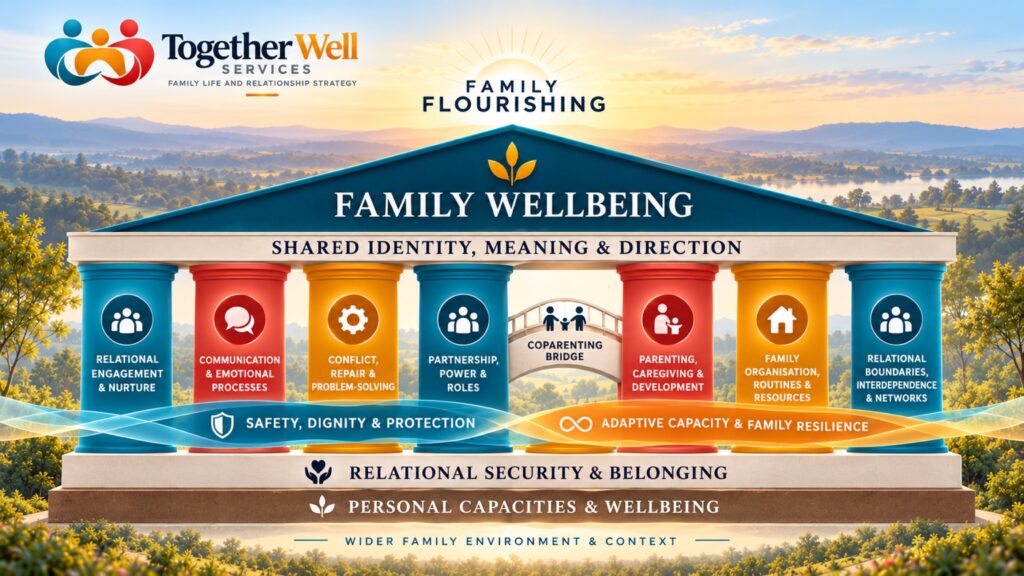
Understanding the Structure
The Architecture includes:
- The Ground — Personal Capacities & Wellbeing: The individual capacities and wellbeing that influence participation in family life.
- The Foundation — Relational Security & Belonging: The dependable care, dignity, acceptance and connection that support healthy family relationships.
- The Seven Structural Pillars: The major relational and practical dimensions through which everyday family life is organised and experienced.
- The Integrating Frame — Shared Identity, Meaning & Direction: The shared values, commitments and sense of direction that help connect the different parts of family life.
- The Cross-Cutting Safeguard — Safety, Dignity & Protection: The responsibility to protect people from harm and preserve their dignity throughout family life.
- The Cross-Cutting Reinforcement — Adaptive Capacity & Family Resilience: The capacity to respond, adjust and reorganise during changing circumstances and difficult seasons.
- The Roof — Family Wellbeing: The quality of family life that emerges through the interaction of these dimensions.
- The Horizon — Family Flourishing: The continuing possibility of growth, meaningful relationships and positive contributions across generations.
These elements are interconnected rather than independent compartments.
A family may demonstrate strength in one area while experiencing strain in another. Improvement in one dimension can support progress elsewhere, but strengths in one area do not cancel out serious concerns about safety, dignity or protection.
The Architecture helps us see the family as a whole without overlooking the experiences and needs of individual family members.
Understanding the Seven Pillars of Family Wellness
The seven structural pillars describe important dimensions of everyday family life. Each pillar contributes to family functioning, but none operates independently of the others.
Pillar 1 — Relational Engagement & Nurture
Healthy family relationships require more than living together or sharing responsibilities. They need intentional attention, affection, responsiveness and meaningful connection.
Relational engagement involves being present, showing interest, offering encouragement and responding appropriately to one another’s needs.
Nurture is expressed through everyday actions that communicate care, respect and belonging.
The central question: How intentionally do we nurture connection and care within our family?
Pillar 2 — Communication & Emotional Processes
Communication is not simply the exchange of information. It also involves how family members listen, interpret messages, express emotions and respond to one another.
Misunderstandings, unspoken expectations, emotional withdrawal and reactive communication can create distance even where genuine affection exists.
Healthy communication involves clarity, respectful expression, attentive listening and growing emotional awareness.
The central question: How do we communicate, understand emotions and respond to one another?
Pillar 3 — Conflict, Repair & Problem-Solving
Disagreements are a normal part of family life. What matters is how they are handled and whether family members can address difficulties responsibly.
This pillar concerns constructive disagreement, accountability, appropriate repair and collaborative problem-solving.
Repair may involve acknowledging harm, taking responsibility, making appropriate changes and rebuilding trust where possible.
Repair should never be used to pressure someone to remain in an unsafe situation.
The central question: How do we handle disagreements, repair harm and solve problems?
Pillar 4 — Partnership, Power & Roles
Families function through responsibilities, decisions, authority and cooperation.
This pillar examines how family members share responsibilities, negotiate expectations, exercise influence and make decisions.
Healthy partnership requires attention to fairness, dignity, capability and the wellbeing of those affected by decisions.
Power differences matter. Authority should be exercised responsibly rather than through intimidation, coercion or exploitation.
The central question: How do we share responsibilities, exercise authority and make decisions?
Pillar 5 — Parenting, Caregiving & Development
Families provide important environments for care, guidance, learning and development.
This pillar addresses parenting practices, caregiving relationships, developmental needs, appropriate boundaries and the support family members require across different stages of life.
Children need protection, responsive care and age-appropriate guidance. Other family members may also require additional support because of illness, disability, ageing or changing circumstances.
The central question: How do we provide appropriate care, guidance and developmental support?
Pillar 6 — Family Organisation, Routines & Resources
Family wellbeing is influenced by how everyday life is organised.
Household responsibilities, financial decisions, routines, time management, caregiving arrangements and access to resources all shape family experiences.
When responsibilities are unclear or resources are stretched, relational tension may increase.
Healthy family organisation involves realistic planning, responsible stewardship, cooperation and adjustment to changing needs.
The central question: How effectively do we organise responsibilities, routines and available resources?
Pillar 7 — Relational Boundaries, Interdependence & Networks
Families exist within wider networks of relationships, including relatives, friends, faith communities, workplaces and society.
These connections can provide belonging, practical assistance, encouragement and support. They can also introduce competing expectations, pressures or boundary difficulties.
Healthy boundaries help families maintain appropriate connections while protecting dignity, responsibility, privacy and the needs of individual members.
In African family settings, this may include navigating extended-family obligations, intergenerational expectations and relationships with in-laws.
The central question: How do we maintain healthy boundaries while benefiting from supportive relationships and networks?
The Pillars Work Together
These seven pillars should not be treated as separate boxes or a checklist for judging families.
Communication influences conflict resolution. Partnership and roles affect parenting and caregiving. Family organisation shapes the time and energy available for relational connection. Boundaries influence how families manage responsibilities within wider networks.
Understanding these relationships helps families recognise that an apparent difficulty in one area may involve several interconnected dimensions.
The goal is not perfection in every pillar, but responsible attention to the relationships, practices and conditions that support family wellbeing.
How the Whole Architecture Works Together
The Architecture of Family Wellness is designed to help us understand family life as an interconnected whole.
Just as a building depends on the relationship between its structural components, family wellbeing is influenced by the interaction of personal capacities, relational security, everyday family practices, shared direction and the wider circumstances in which people live.
Understanding the whole Architecture helps families look beyond isolated problems without overlooking the needs and experiences of individual members.
The Ground — Personal Capacities & Wellbeing
Every family is made up of individuals with their own emotional, physical, psychological, relational and developmental needs.
Personal capacities influence how family members manage emotions, respond to stress, communicate, fulfil responsibilities and participate in relationships.
When an individual is experiencing exhaustion, prolonged stress or other significant difficulties, their capacity to engage in family life may be affected.
Strengthening family wellness therefore includes attending to individual wellbeing, not merely demanding better relational behaviour.
The Foundation — Relational Security & Belonging
Relational security and belonging form the Foundation of the Architecture.
Family members need relationships in which they can experience appropriate care, dignity, acceptance, dependable connection and a meaningful sense of belonging.
Relational security supports trust, openness and the ability to navigate ordinary disagreements.
However, belonging must not be confused with compulsory togetherness. Healthy belonging respects personal dignity, appropriate boundaries and safety.
The Integrating Frame — Shared Identity, Meaning & Direction
Families are influenced by the values, commitments, traditions, beliefs and goals that give meaning to their shared life.
The Integrating Frame helps connect the different dimensions of family functioning around a sense of identity and direction.
It invites families to consider what matters to them, how their values influence everyday decisions and what kind of family life they are intentionally building.
Shared direction should not require uniformity of opinion or suppress the legitimate needs and individuality of family members.
The Cross-Cutting Safeguard — Safety, Dignity & Protection
Safety, dignity and protection apply throughout the entire Architecture.
Family wellbeing cannot be established merely by identifying strengths in communication, organisation, shared values or other areas while ignoring violence, abuse, coercion or serious threats to safety.
Protecting family members includes recognising vulnerability, respecting personal dignity, maintaining appropriate boundaries and responding responsibly when harm occurs.
Safety is not simply another family wellness goal. It is a fundamental condition that must be considered across every dimension of family life.
Where protection concerns arise, appropriate safeguarding and qualified specialist support take priority over ordinary family reflection exercises.
The Cross-Cutting Reinforcement — Adaptive Capacity & Family Resilience
Families encounter transitions, uncertainty and pressures that require adjustment.
These may include childbirth, adolescence, marriage transitions, unemployment, relocation, illness, bereavement, ageing or changing caregiving responsibilities.
Adaptive capacity concerns how families respond and reorganise when circumstances change.
Family resilience involves drawing on available strengths, relationships, resources and support to navigate difficulties while protecting wellbeing.
Resilience does not mean tolerating abuse, denying distress or pretending that hardship has no consequences.
Sometimes resilience includes seeking outside assistance or changing an arrangement that is no longer safe or sustainable.
The Roof — Family Wellbeing
The Roof represents Family Wellbeing.
It reflects the quality of family life that emerges through the interaction of the Architecture’s different dimensions.
Family wellbeing includes the experiences of individual members as well as the functioning of the family as a relational system.
It cannot be reduced to one achievement, one person’s satisfaction or a single numerical score.
A family may have meaningful strengths while still needing attention in particular areas.
The Horizon — Family Flourishing
Family Flourishing represents the wider horizon towards which healthy family development can contribute.
It includes the possibility of meaningful relationships, responsible growth, personal development, supportive family environments and positive contributions to communities and future generations.
Flourishing is not a permanent state of perfection or a guarantee that families will never experience hardship.
It is an ongoing direction of development shaped by opportunities, relationships, responsibilities and circumstances.
Why Integration Matters
Consider a family experiencing repeated disagreements about money.
At first, the difficulty may appear to be a communication problem. But closer examination may reveal financial pressure, unclear responsibilities, competing extended-family obligations, different expectations about decision-making and emotional exhaustion.
Improving communication may be helpful, but the family may also need clearer agreements, realistic budgeting, fairer responsibilities or additional practical support.
This is why the Architecture encourages families to examine how different dimensions influence one another.
Family wellness is strengthened not by treating each difficulty in isolation, but by understanding the relationships, capacities, practices and conditions that shape family life as a whole.
Families Within Their Real-Life Context
Every Family Exists Within a Wider Environment
No family exists in isolation.
Family relationships are shaped not only by what happens between family members but also by the economic, social, cultural, religious and institutional environments in which they live.
Employment conditions, housing, education, healthcare, community expectations, government policies and access to support can all influence family wellbeing.
The Architecture of Family Wellness therefore encourages families to consider both their internal relationships and the wider circumstances affecting everyday life.
A family may be experiencing genuine relational difficulties while also facing pressures that cannot be resolved through communication or personal effort alone.
Economic Pressures and Family Responsibilities
Financial realities can significantly influence family experiences.
Unemployment, unstable income, rising living costs, housing challenges and the demands of providing for children or dependent relatives may place considerable pressure on individuals and relationships.
For some families, financial obligations extend beyond the immediate household to parents, siblings and other relatives.
These responsibilities may express valuable traditions of care and interdependence. However, they can also create difficult decisions when available resources are limited or expectations are unclear.
Strengthening family wellness may therefore involve financial planning, realistic agreements, clearer responsibilities and access to practical support—not simply encouraging family members to communicate better.
Extended-Family Relationships and Interdependence
Across many African societies, family life extends beyond parents and children.
Grandparents, siblings, aunts, uncles, in-laws and other relatives may play important roles in caregiving, financial support, social belonging and family decision-making.
These relationships can be significant sources of strength.
They may also introduce challenges involving privacy, boundaries, authority, competing loyalties and expectations about responsibility.
Healthy family functioning does not necessarily require withdrawing from extended-family relationships. Rather, it involves developing appropriate boundaries while preserving dignity, care and supportive interdependence.
Culture, Tradition and Changing Expectations
Cultural traditions influence how families understand marriage, parenting, respect, gender roles, authority, caregiving and obligations between generations.
These traditions can preserve important values, provide identity and strengthen community connections.
At the same time, families may need to examine whether particular expectations remain appropriate, fair and consistent with the dignity and wellbeing of everyone involved.
Differences between generations may become more visible as education, technology, employment patterns, migration and social expectations change.
The Architecture encourages families to approach these differences thoughtfully rather than assuming that every traditional practice is harmful or that every modern preference is automatically beneficial.
Parenting and Development Across Generations
Family needs change as members move through different stages of life.
The arrival of a child, the transition into adolescence, young adulthood, marriage, ageing and increasing caregiving needs can require adjustments in roles, routines, boundaries and expectations.
Parents may also be navigating differences between the parenting approaches they experienced growing up and the knowledge or practices they now wish to adopt.
Healthy adaptation involves recognising developmental needs, maintaining appropriate guidance and protection, and responding to changing circumstances without abandoning responsible family values.
Faith, Meaning and Family Life
For many Nigerian and African families, religious faith plays a meaningful role in family identity, values, decisions and sources of support.
Faith communities may provide belonging, encouragement, moral guidance and practical assistance during difficult seasons.
Christian families may draw on biblical principles such as love, faithfulness, humility, responsibility, justice, forgiveness and care for others.
However, spiritual practices should not be used to dismiss emotional distress, developmental needs, harmful behaviour or legitimate safeguarding concerns.
Prayer should accompany responsible action rather than replace it. Forgiveness should not eliminate accountability, and appeals to family unity or religious authority should never be used to justify abuse or coercion.
TogetherWell’s approach is faith-sensitive while respecting families and individuals from different religious backgrounds.
Families Are Diverse
Families differ in composition, resources, experiences and circumstances.
Some are raising young children. Others include adolescents, adult children, ageing parents or relatives requiring additional care. Some are single-parent, blended, multigenerational or living across different locations.
These differences affect the responsibilities, strengths and challenges families experience.
The Architecture is intended to support thoughtful reflection across different family situations rather than impose one rigid picture of what every family must look like.
Understanding Context Without Removing Responsibility
Recognising environmental and cultural influences does not mean excusing harmful conduct or denying personal responsibility.
It means understanding that meaningful family improvement sometimes requires more than changing individual attitudes or communication habits.
A family may need practical resources, revised expectations, professional support, safer arrangements or changes in how responsibilities are distributed.
Healthy family development requires attention to both relationships and the real-life conditions in which those relationships operate.
From Understanding to Action
Turning Family Wellness Insights into Practical Change
Understanding family wellness is important, but understanding alone does not automatically produce change.
A family may recognise recurring communication difficulties, unclear responsibilities, strained relationships or weaknesses in everyday routines without knowing where to begin.
The Architecture of Family Wellness provides a framework for understanding these concerns. TogetherWell’s practical resources and relationship strategy approach help individuals and families translate that understanding into responsible action.
The goal is not to change everything at once. It is to identify what matters, understand what is happening and develop realistic steps towards healthier family functioning.
A Structured Approach to Family Wellness
TogetherWell uses a systematic relationship strategy process:
- ASSESS
- UNDERSTAND
- IDENTIFY PATTERNS
- DEFINE OUTCOME
- DEVELOP STRATEGY
- IMPLEMENT
- REVIEW
Each stage serves a practical purpose.
Assess — Recognise the Present Situation
Begin by considering the family’s existing strengths, experiences, circumstances and areas needing attention.
Assessment in this context means structured reflection, not clinical diagnosis or assigning a numerical grade to a family.
Understand — Explore What Is Happening
Look beyond the most visible difficulty.
Consider the perspectives of family members, relevant relationships, responsibilities, developmental needs and environmental pressures.
Identify Patterns — Recognise What Keeps Repeating
Explore recurring interactions, expectations, behaviours and circumstances that may be contributing to the difficulty.
The aim is to understand the process rather than simply identify someone to blame.
Define Outcome — Clarify What Needs to Change
Describe the improvement you hope to see.
A useful outcome should be realistic, responsible and attentive to the dignity, wellbeing and safety of those involved.
Develop Strategy — Choose Appropriate Actions
Identify practical steps, available strengths, needed resources and possible sources of support.
A strategy may involve improving communication, clarifying responsibilities, adjusting routines or addressing wider practical conditions.
Implement — Put the Strategy into Practice
Begin with manageable actions.
Agree on responsibilities where appropriate, establish realistic timelines and allow room for learning and adjustment.
Review — Learn and Make Adjustments
Reflect on what has happened.
What improved? What remains difficult? What assumptions need reconsideration? Is additional support required?
Review helps families respond thoughtfully rather than continuing an ineffective approach.
Begin with Practical Family Wellness Resources
TogetherWell provides guided resources to support different stages of this process.
Family Wellness Starter Guide
An introduction to the Architecture of Family Wellness and practical ways to begin reflecting on family life.
Family Pattern Map
Helps individuals and families examine an ordinary recurring interaction, understand its sequence and identify possible turning points.
Difficult Conversation Planner
Supports preparation for important conversations through clearer thinking, respectful communication and responsible planning.
Family Values, Vision & Direction Conversation Guide
Helps families reflect on what matters to them and develop a clearer sense of shared identity, values and direction.
Family Priority Worksheet
Supports the identification of a manageable family wellness priority rather than attempting to address every concern simultaneously.
Family Wellness Strategy Plan
Helps translate an identified priority into practical actions, responsibilities, support arrangements and review.
These resources can be used individually or in combination, depending on the family’s needs. They are not a compulsory sequence.
When Self-Directed Reflection Is Not Enough
Not every family difficulty can be addressed through a worksheet, conversation or educational resource.
Where there are concerns involving abuse, coercive control, serious threats, child protection, significant psychological distress or other matters requiring specialist intervention, safety and appropriate professional support should take priority.
Family wellness education and coaching should complement—not replace—qualified clinical, safeguarding, legal or other specialist services when those services are needed.
Progress Begins with a Responsible Next Step
Family development rarely happens through one dramatic decision.
Often, progress begins with a clearer understanding, a more constructive conversation, a realistic agreement, a healthier boundary or a practical adjustment to everyday responsibilities.
The Architecture helps families see the wider picture. Structured reflection and strategy help them decide what to do next.
Understand your family’s strengths and challenges. Identify what matters most. Develop a responsible strategy. Take practical steps. Review and keep growing.
Begin Strengthening Your Family Wellness
Understanding Is the Beginning. Intentional Action Makes the Difference.
Every family has strengths worth preserving, challenges worth understanding and opportunities for growth.
The Architecture of Family Wellness provides a way to see the bigger picture. It helps individuals, couples and families recognise how relationships, responsibilities, personal wellbeing, shared values and everyday circumstances influence one another.
You do not have to address everything at once.
Begin by understanding where you are, identifying what deserves attention and taking one responsible step towards healthier family life.
Explore Our Family Wellness Resources
TogetherWell provides practical guides, reflection worksheets and strategy tools designed to help you apply Family Wellness principles to everyday situations.
Whether you want to strengthen communication, understand recurring difficulties, clarify family priorities or develop a practical improvement plan, our Family Wellness Resources collection provides a starting point.
Get Support for Your Family Wellness Journey
Some family concerns benefit from additional guidance, structured education or professional support.
TogetherWell Services offers family-life education, relationship strategy, coaching and practical learning opportunities to help individuals, couples and families navigate challenges and strengthen their relationships.
Our approach is evidence-informed, culturally responsive, faith-sensitive and attentive to professional boundaries.
Where a concern requires clinical, safeguarding, legal or other specialist intervention, appropriate referral and safety considerations take priority.
Stronger Families Are Built Intentionally
Family wellness is not about achieving perfection. It is about developing the relationships, capacities, practices and conditions that help people live well together.
Understand the Architecture. Strengthen what matters. Build towards family flourishing.